
Veterinary client retention guide
Five veterinary client retention strategies that start after the appointment
For practice owners and managers: five ways to keep clients engaged between visits, and how to measure each one.
No credit card required. Send your first care guide today.
Retention is decided between visits
Most clinics do good work inside the building. Then the owner goes home with medications and a discharge sheet, and things go quiet until the next visit. That’s when clients decide whether to come back.
- Half
- of owners who left a practice did so over customer service, not medical care
- Veterinary Sciences, 2018
Keeping a client also costs far less than finding a new one. A 5% increase in customer retention has been shown to lift profits by 25% to 95% (Harvard Business Review, 2014). These five veterinary client retention strategies focus on that time between visits.
Check your clinic in five questions
Any “no” points to the strategy to read first.
Strategy 1: Make aftercare easy to follow
Discharge packs a lot into a few minutes, for an owner who’s worried and ready to leave. In one study, owners and their vet agreed on only two-thirds of what was said, and far less on side effects and confinement (J Vet Intern Med, 2024).
What helps owners follow aftercare
- A home plan written for this pet, covering medications, restrictions and warning signs
- Tasks tied to clear times, such as tonight, day three or before the recheck
- Answers to common “Is this normal?” questions, so owners don’t need to call
- A check-in a day or two after the visit to reassure owners and catch problems early
How to measure aftercare
- Aftercare call rate, with the top reasons for calls
- Recheck attendance rate
- Home plan task completion rate
Strategy 2: Turn new clients into second visits
New clients cost money to bring in, whether through ads, a discounted wellness exam or a referral. Many leave with a list of recommendations and no real connection to your team, yet half of new clients expect you to follow up (dvm360, 2018).
What helps new clients come back
- A written plan showing what you recommended, why, and when it’s due
- Next steps with dates: the next vaccine, the dental, the bloodwork
- An easy way to ask a question without calling
- The next visit booked before they leave
How to measure second visits
Strategy 3: Make care recommendations stick
In the exam room, the owner says yes to the booster, the senior bloodwork, the recheck. Then the date slips, the reason blurs, and six months later it’s forgotten.
What helps clients follow through on recommendations
- The same explanation from the vet, the tech and the front desk
- Each recommendation and its reason written down before the owner leaves
- A due date and a reminder for each recommendation
- Follow-up on anything accepted but not yet done
How to measure follow-through
Strategy 4: Stay connected between visits
Between appointments, most clients hear from you once: a reminder. When a question comes up, they ask the internet or a friend, and your clinic isn’t part of the pet’s everyday care.
What keeps clients engaged between visits
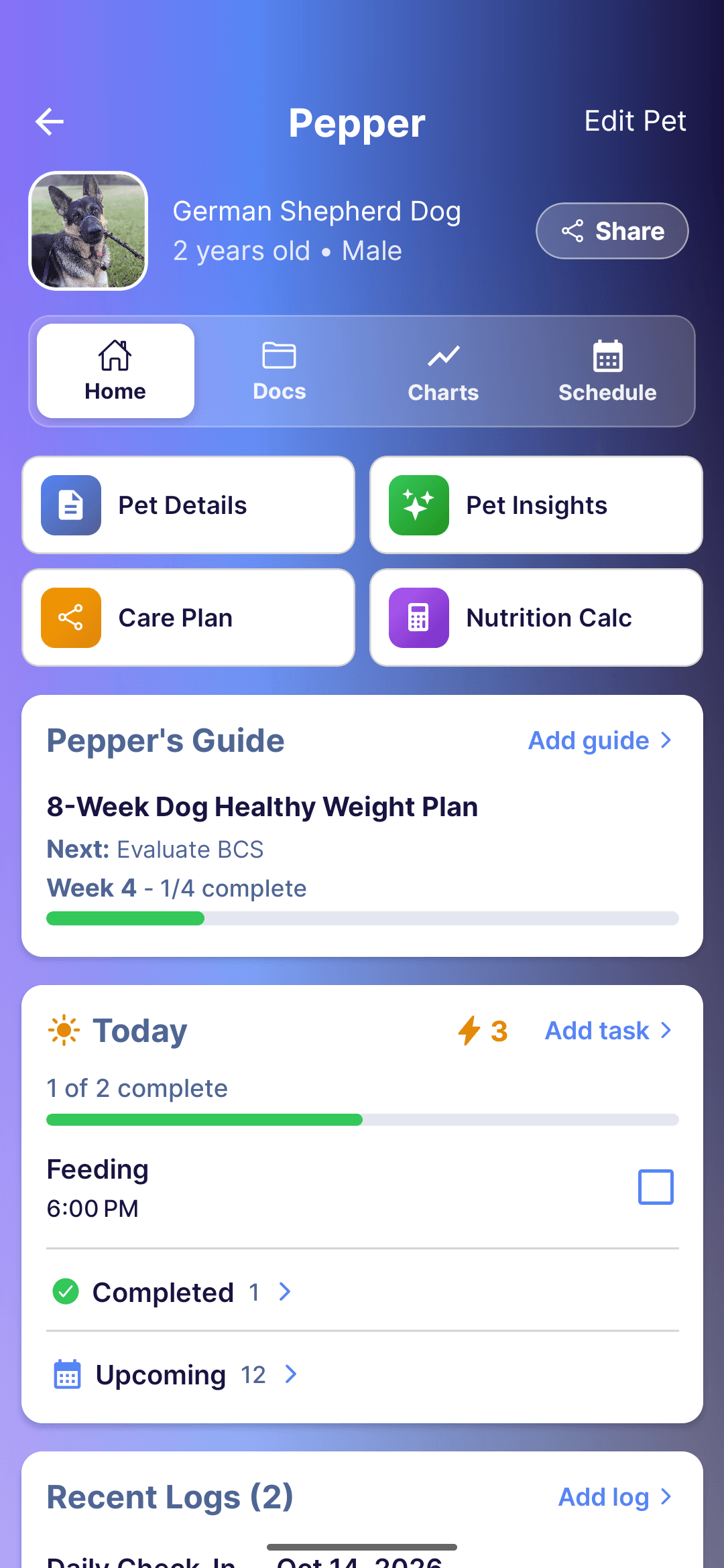
- A care plan and calendar owners check each week
- Requests for updates at the right moment, like a photo of the incision after surgery
- Quick answers to small questions, so owners don’t need a phone call
- Updates about their own pet, not a general newsletter
How to measure engagement
- Between-visit engagement rate, broken out by tasks completed, updates or documents shared, and messages sent
Strategy 5: Win back newly overdue patients
Most practices chase lapsed clients once or twice a year with one “we miss you” email. By then, many have settled somewhere else. Reach them the month they first go overdue, while the list is short.
What helps bring overdue patients back
- Review the newly overdue list every week
- Update the record first, because some owners have moved, some have switched clinics and some pets have died
- Send one clear next step for each pet, and log the outcome so nobody gets the same message twice
How to measure win-backs
- Newly overdue patients per month
- Reactivation rate
How Care Connect supports your client retention program
Here's how Care Connect helps with the first four strategies. It works alongside your existing PIMS.
No credit card required. Send your first care guide today.
Or try it now with your own discharge instructionsTurn your discharge into a care guide
Care Connect sends owners timed tasks, reminders and check-ins for their pet, and shows your team who’s on track. More on improving aftercare compliance.Give every new client a plan to follow
Recommendations from the exam become a structured weekly plan, and your team can see who hasn’t acted yet.Put recommendations on the owner's calendar
Recommendations go into the care guide with your explanation and a due date. Owners see what’s due and why, and receive reminders to follow through.Give clients an app they use all year
The Every Wag app keeps check-ins, reminders and records in one place, and brings owners’ updates and questions back to your team.

“Everything from intake to the care plan lives in one place now. We spend less time chasing paperwork and more time with our patients.”
Veronica Torres, CVT
Owner, Vet Tech 2 U
What about veterinary loyalty programs?
Points and punch cards can help, but a veterinary client loyalty program rarely keeps clients on its own.
- Loyalty program
- Rewards purchases and visits with points, discounts or perks. Useful for repeat buys like parasite prevention.
- Client retention program
- Keeps clients engaged with their pet’s care between visits, through clear aftercare, reminders and personal follow-up. A stronger driver of loyalty than points or perks.
Clients stay when they understand the plan and can reach someone with a question. Add rewards on top of that, not instead of it.
How to measure veterinary client retention
Strategy 1: Aftercare
- Aftercare call rate
- How often owners call for help after a visit.
- How to calculate: Calls within 14 days of a visit, divided by visits sent home with a plan. Tag each call with a reason (medication, incision, appetite) to see which instructions need work.
- Recheck attendance rate
- How many recommended rechecks happen.
- How to calculate: Rechecks done by the due date, divided by rechecks recommended.
- Home plan task completion rate
- How much of the home plan owners complete.
- How to calculate: Tasks marked done on time, divided by tasks assigned. Needs an app that records when owners check off a task.
Strategy 2: Second visits
- First-to-second-visit rate
- How many new clients come back.
- How to calculate: New clients who return within 12 months, divided by all new clients. Only count clients whose first visit was at least 12 months ago.
- Forward booking rate
- How often the next visit is booked before the client leaves.
- How to calculate: Next visits booked at checkout, divided by next visits recommended.
Strategy 3: Recommendations
- Recommendation acceptance rate
- How many recommendations clients agree to.
- How to calculate: Recommendations accepted, divided by recommendations made.
- Recommendation completion rate
- How much of what clients agree to gets done.
- How to calculate: Accepted recommendations done by the due date, divided by all accepted. Start with one type, such as dentals.
Strategy 4: Engagement
- Between-visit engagement rate
- How many clients stay in touch between appointments.
- How to calculate: Active clients who completed a task, shared an update or sent a message, divided by all active clients. Needs an app or messaging tool that records this.
Strategy 5: Overdue patients
- Newly overdue patients
- How many patients slipped past a due date this month.
- How to calculate: Patients whose annual exam or core vaccine became more than 30 days overdue this month, as a count and as a share of active patients.
- Reactivation rate
- How many overdue patients come back after you reach out.
- How to calculate: Contacted patients who visit within 60 days, divided by all patients you contacted. Leave out records removed in cleanup.
Where to start this month
- Today: pull the overdue list and call the ten most recently overdue.
- This week: add a “what’s normal” section to your most common discharge sheet.
- Next: pick one recommendation and track accepted against completed.
- Then: count how many of last year’s new clients came back for a second visit.
- Finally: send clients one useful message between visits.
Client retention FAQ
What are the most effective veterinary client retention strategies?
How do you measure client retention in a veterinary practice?
When should a practice follow up with a newly overdue patient?
Does Care Connect replace our PIMS?
Sources
- PetDesk, Pet Parent Research Report (2025) — survey of 1,000 North American pet owners.
- Brown BR. The Dimensions of Pet-Owner Loyalty and the Relationship with Communication, Trust, Commitment and Perceived Value. Veterinary Sciences (2018) — 351 pet owners recruited through social media, of whom 140 had left a practice.
- Flegel T, et al. Client's understanding of instructions for small animals in a veterinary neurological referral center. Journal of Veterinary Internal Medicine (2024) — 151 dog and cat owners at one referral center.
- Englar RE, Show-Ridgway A. Post-appointment follow-up: what veterinary clients say they want. dvm360 (2018) — anonymous online survey of 100 veterinary clients.
- Gallo A. The Value of Keeping the Right Customers. Harvard Business Review (2014) — Bain & Company research on customer retention and profit.
Build loyalty between visits.
Care Connect gives owners a plan to follow at home and shows your team who needs a follow-up.
No credit card required. Send your first care guide today.